Less Reacting, More Control
Many of us start the week with a full calendar, a backlog of emails, people waiting on us and a pile of admin.
It’s tempting to react to everyone else’s demands, putting one foot in front of the other and hoping for the best. Over time, that can become stressful and demoralising.
It doesn’t have to be this way.
What is an Ideal Week Blueprint?
An Ideal Week Blueprint is a simple picture of how you’d ideally use your time in a pretty good week.
Not a rigid schedule. Not a fantasy week where nobody interrupts you.
Real weeks will rarely match your blueprint perfectly, and that’s fine. The trick is to hold it lightly.
What matters is that you’ve designed it and have something to steer towards. Less reacting. More control.
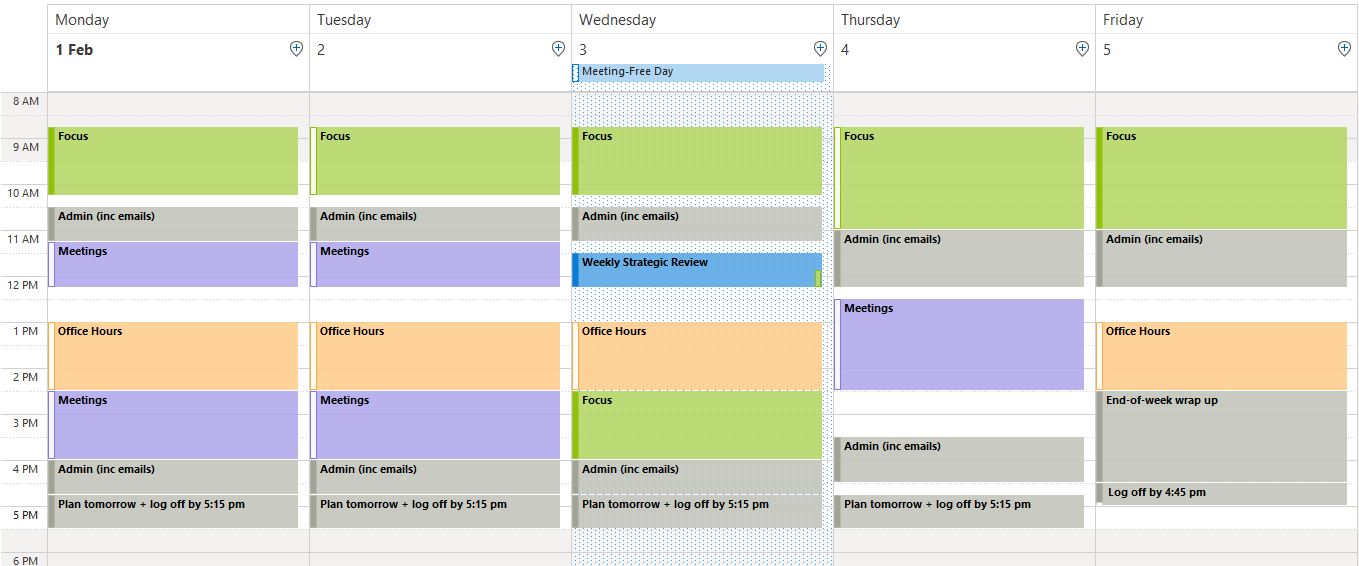
Why create one?
1. See how much discretionary time you really have
Discretionary time is what’s left after you account for meetings, email, admin and other fixed commitments. It’s often far less time than we imagine. But if you only have six hours of discretionary time a week, those hours become precious, and you’re more inclined to protect them.
2. Make space for important work
Think about the work you most want to be known for. Does your week make room for it?
I block out time for this work in advance. I call it focus time. It protects space for important work before it becomes urgent, helping avoid last-minute stress and scrambling.
3. Make boundaries easier to hold
A colleague asks, “Have you got a minute?” Often, you do, and collaboration is valuable. But the problem is when these interruptions expand until you have no time left for your own work.
An Ideal Week Blueprint makes that trade-off visible. It helps you be more intentional about when you are available to others, and when to protect your own time.
4. Make weekly planning easier
When each kind of work has a regular place in your weekly blueprint, you stop asking, “When am I going to do that?”
Your planning question shifts from “How will I fit everything in?” to “What’s different this week?” Instead of planning from scratch, you simply rearrange.
How to create your blueprint.
1. Start with a blank week
Find an empty week in your calendar and view the whole week on a big screen.
Why the big screen? Research suggests that people using paper created better plans and were more likely to follow through. The advantage seems to come from seeing the whole picture at once – and a big screen gives you that benefit.
Prefer paper? Go for it.
And remember, colour-code activities to differentiate different types of work.
2. Add your fixed commitments
Start with what can’t easily move, at work and at home. Think: team meetings, client commitments, school drop-offs, exercise and your start and finish times.
Then ask yourself: “When do I want time with the people who matter most? What keeps me well?”
We’re good at scheduling obligations. We’re not always as good at protecting what makes life meaningful.
3. Protect time to focus
When are you at your best for focused or creative work? For many people, it’s the morning.
Where you can, protect 90–120-minute blocks in your calendar for this work. That’s enough time to make real progress. Aim for a regular rhythm, like Tuesday, Wednesday and Thursday mornings.
4. Decide where meetings belong
You may not control every meeting, but you likely have more influence than you think.
Could you batch meetings into certain afternoons? Protect a meeting-free day? Offer Office Hours for quick questions?
5. Give email and admin a home
Email doesn’t need to run in the background all day.
Give email and admin tasks a regular home in your week rather than letting them fragment your attention.
6. Leave room for the unexpected
Some roles are reactive. Pretending otherwise won’t change that. So, leave white space for the unplanned and for catching your breath.
7. Step back and review
Now zoom out. Don’t just ask, “Does everything fit?” Ask:
- Does this look like someone doing my job well?
- Is there space for the work I want to be known for?
- Where am I likely to get overloaded?
- Have I left room for the unexpected?
If your first reaction is “This looks exhausting”, pay attention. The aim isn’t to fill every minute. It’s to create a rhythm you can sustain.
Now test it in real life.
Keep your blueprint somewhere visible (print it if you’ve created it digitally). Take a few minutes at the end of each day to check tomorrow against it and confirm your priorities.
Experiment. Keep what helps. Change what doesn’t.
Create a repeatable week, not a perfect one.
The blueprint serves you, not the other way around. Its real value is giving you the chance to think about your time before everyone else’s priorities compete for it.
The goal isn’t a perfect week. It’s a “pretty good” week that’s easier to repeat.
Keen to read more? These articles explore related ideas:
- Office Hours: How to Protect Focus and Build a Stronger Team
- The Quiet Protocol: Lift Productivity by 65%
- Time Confetti is Ruining Your Focus (here’s how to fix it!)
